
Creative Destruction: Portrait of an Idea
The phrase creative destruction has resonated with me since I first heard it, and since then, it has been an organizing magnet in my mind for a variety of ideas. I was reminded of the concept again this weekend while reading William Duggan's Strategic Intuition, which mentioned Joseph Schumpeter as a source of inspiration. Visually, I associate the phrase most with Escher's etching, Liberation, which shows a triangular tessellation transforming into a flock of birds. As the eye travels up the etching, the beauty of the original pattern must be destroyed in order that the new pattern may emerge
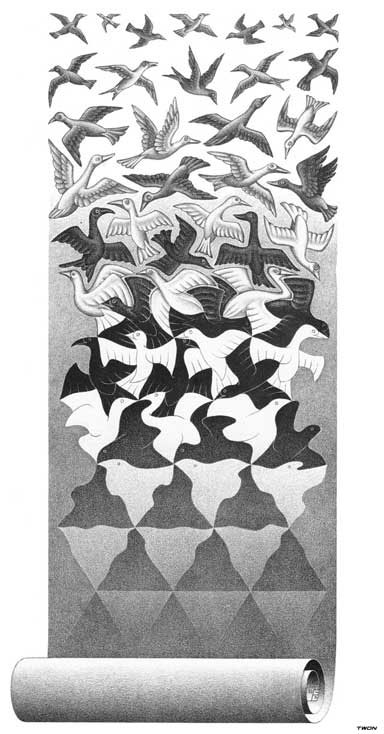
(All M.C. Escher works (c) 2008 The M.C. Escher Company - the Netherlands. All rights reserved. Used by permission. ):
I don't know when I first heard the phrase, but I first used it in the frontispiece of my PhD thesis. Here are the three quotes I put there, back in 2003, when I was searching for just the right sort of imagery to give my research the right-brained starting point it needed. My first quote was a basic, bald statement due to Schumpeter:I followed that up with a Rabindranath Tagore bit that I'd found somewhere (update: Googling rediscovered the 'somewhere' -- on the frontispiece of Hugo Reinert's draft version of a paper on Creative Destruction which seems to have finally appeared in the collection: Friedrich Nietzsche: Economy and Society), and for which, to this day, I haven't found a citation (update: Hail! Google books; a work-colleague, Tom K., dug the reference out for me -- the extract is from Brahma, Vishnu, Siva, which appears in Radice's translation of selections from Tagore -- so much for the detractors of Google's book scanning project: plain Googling did not get me the source).``Creative Destruction is the essential fact about capitalism."
-- Joseph Schumpeter, Capitalism, Socialism, and Democracy
And concluded the Grand Opening of my Immortal Thesis with a dash of Nietzsche:From the heart of all matter Comes the anguished cry Wake, wake, great Siva, Our body grows weary Of its law-fixed path, Give us new form Sing our destruction, That we gain new life…
-- Rabindranath Tagore
Curiously, I haven't read any of these (something I don't mind admitting, since I actually read a lot more of the books I quote than most people). For me creative-destruction has always been a right-brained sort of thing. In fact I almost titled my thesis ``The Creation and Destruction of Teams" but I decided that was way too ponderous and self-important, even for me, and settled for the more prosaic ``Team Formation and Breakup in Multiagent Systems." But throughout the process of doing the research and writing up the results, the metaphor of creative destruction and the associated imagery was in my mind. Sometimes I dreamed of swarms of airplanes making and breaking formation (formation flight was one of the applications I worked on). But looking further back, I can see that my first serious infatuation with the idea goes further back to a beautiful Urdu poem by Ali Sardar Jaffri, Mera Safar, ably translated by Philip Nikolayev. Nowhere else have I encountered the idea captured with such poetic precision. If you know Hindi/Urdu, reading the original is well worth it. The infatuation continues -- creative destruction is at the heart of my latest research at work.``[H]ow could you wish to become new unless you had first become ashes!"
-- Freidrich Nietzsche, Thus Spake Zarathustra (Dover Thrift Editions)
3 Comments
It's a nice read, I relly appreciate the leads on the origins of Creative Destruction. I am studying Schumpeter in Economics ight now, and we glossed over Hegel a month back. I didn't see the linkage there, or the 'phoenix' metaphor. We always view creative destruction in econ as two isolated, simultaneous events- creation here, destruction there; and on the whole (macro vew) it's all ok, or better than before, or worse than than before (which is true is the point of contention)
Thanks again!
Thanks for the thoughtful post! I like the connection with Escher's Liberation, in particular.
I loved the Tagore quote about creative destruction. Thanks.