
Megacommunities and Macrotrends
Where I work, at Xerox, overcomplicated/over-ambitious ideas often prompt the remark, "Let's not try to solve world hunger here." The remark is usually apt, and leads to productive simplification and pragmatism. What do you do, however, when world hunger really is the problem you want to solve? That's what this piece is about.
The Gap
So why is original thinking needed here? The story of my own disengagement from big "causes" is probably as good an illustration as any. About eight years ago, in my first incarnation as an online writer, at Sulekha.com, I used to write a column called Wide Angle. It was mainly armchair analysis of big, global issues, as best as I could grapple with them. The last column I wrote then was on the notorious
It was a powerfully educational and powerfully discouraging experience for me. The intricate web of conflicting motives, the radicalized atmosphere, with non-profit, business and government entities talking past each other, the rampant public posturing for a polarized media -- the whole circus convinced me that this was not an effective way to solve big problems. Though I returned from my trip and wrote up my piece, the experience was such a damper that I stopped writing the column – what was the point of reading and writing about big issues if no effective ways to act were available? (If you read ribbonfarm.com regularly, you'll have noticed that though I range widely over many topics, I rarely touch "big" issues).
What bothered me was a trite observation. It seemed to me obvious that the big problems could not be solved by government, private sector, or non-profit players acting unilaterally. These problems would only yield to serious inter-organizational collaboration models.
Yet, creating such models is insanely hard. There is deep cultural suspicion among the three sorts of players. Each sort of actor derives its legitimacy in part by adopting a polarizing stance that paints the others as bad-faith actors. For each, there is a very real danger that collaboration could be viewed as collusion and subversion of mission.
These abstract ideas were sharply defined for me by a single preachy remark that was made at an NBA meeting in Bombay (at the Tata Institute of Social Sciences) that I observed when I was researching my article. One of the participants (it may have been Medha Patkar herself) said something that included the phrase "the arrogance of engineers." Instantly, the entire room was nodding in sanctimonious agreement, with murmurs of support. As an engineer who rather likes his profession, the remark seriously annoyed me as badly misrepresenting the ethos of modern engineering and industry. I felt an urge to make a sharp remark along the lines of get over yourselves, this isn't just your problem; industry has to be part of the solution, and you're holding your damn meeting in an institute founded by an industrialist. But alongside the annoyance was a dim realization that unproductive though their framing was, they were engaging a serious and real problem. And that industry couldn't solve such problems without them, any more than they could solve the problems without industry.
If I were in the same situation today, I'd suggest a megacommunity.
Megacommunities as the Solution
So let's talk about Megacommunities. The book proposes a careful, well-validated and thoughtful model -- the megacommunity -- for public-private-civil collaboration that can actually take on big challenges.
The book covers some familiar examples, such as the differences in the aftermaths of Hurricane Andrew in
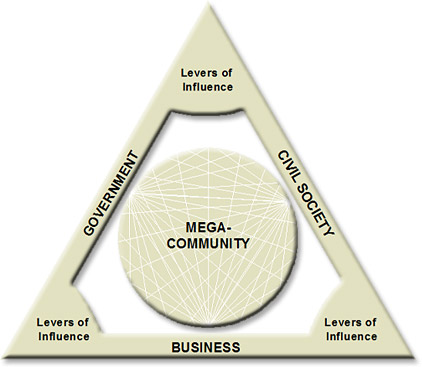
Consider the static nature of most public-private partnerships (PPPs). In order to negotiate a working relationship, both sides expect to isolate the issue upon which they agree and set rules around engagement on the issue. Thus, when conflicts or new issues arise, PPPs do not generally allow for flexible responses. The terms of engagement have been set from the start, and the design has deliberately excluded change because that would be seen as collusion or abandonment of principle. The relationship is locked down.The megacommunity model, by contrast, explicitly recognizes the ambiguous, constantly shifting nature of truly complex problems, and the need for continuously shifting frames and perspectives in search of creative resolution. The idea is succinctly captured in a quote from Harvard's John Ruggie: "Life in the world of sustainable globalization is a permanent negotiation."
The book is carefully structured to serve as both a survey of the state of our global ability to engage big problems (conclusion: poor), as well as a thoughtful operating manual. There is a chapter each on the anatomy of megacommunities and how to think with the model, followed by three chapters on initiating, structuring and sustaining, and leading in a megacommunity. The last is important: due to its network structure, you cannot apply direct leadership models to megacommunities, since the leaders of individual participant organizations do not have formal authority over the others. The style of leadership required is one that allows megacommunity participants to navigate across boundaries and operate in all three cultures (something I talked about in a previous piece on cross-preneurship).
The roadmap and guidelines are particularly well done. Many big-picture books of this sort conclude weakly with silly check-lists, self-assessment tools and assorted vacuous process paraphernalia. Or worse, directing readers to a lame website where effective virtual collective action is expected to miraculously emerge. Thankfully, Megacommunities does not insult the intelligence of readers -- indeed it sets a high standard of expectations on the reader. It seems to assume that the average reader is actually an thoughtful and intelligent person, acting in best-faith ways. I am actually afraid some people who really need to read this book may not be able to process it. And yes, social media are realistically factored in as part of the solution, so this book definitely belongs in my World 2.0 canon map.
The last noteworthy element in the book is the description of the role played by Booz Allen Hamilton. Books by principals of consulting firms are all too often thinly-veiled marketing brochures that deliberately misrepresent issues in order to make their role seem necessary. Megacommunities is a refreshing change. The authors clearly care, and yet do not put on holier-than-thou airs. The role they play (and presumably other consulting firms with practices in this area) is to facilitate strategic simulations and war games designed to initiate working relationships across sector boundaries, and seed megacommunities. Presumably they get paid for this (and should). This appears to be a consulting model that, I can honestly say, seems to be about adding real value. We often joke that consultants charge people to tell them what they already know, or merely create ammunition to justify decisions that have already been made by senior management. This appears to be one role where consultants catalyze, as honest brokers, real change that could not happen without them.
Bridging the Gap
What will it take to make the megacommunity approach the default operating mode around large, important issues?
The IRI conference was a small glimpse of how the world actually sets about tackling big problems today (as well as going after big opportunities, which are too big for any individual company or nation to swallow). The IRI -- industrial research institute -- is a membership organization of about 200 odd corporations and government agencies that was founded by the National Research Council in 1938. At these meetings, senior managers attend to swap notes on how to deal with big challenges. Last week, for instance, the themes addressed were 'energy', 'global water scarcity', 'globalization' and 'networked world.'
In it's own way, the forum seemed to me a limited model, given the sorts of ambitious things it presumed to address. It was mildly disheartening to see that such a powerful assembly of senior managers from corporate America could do little more than talk Powerpoint at each other. But the IRI isn't atypical -- most meta-organizations of this scale or larger, from the G8, to the WEF and the WSF, are able to do little more than produce reports, track metrics, talk too much, and fight too much. Megacommunities should be required reading for the leadership of such bodies, since it offers a way for them to redefine their charters in powerful ways within an ecosystem of megacommunities.
In many ways, the megacommunity model is the first attempt to propose that we really need to think in terms of more complex organizational forms than we are used to, in order to gain traction on problems that are more complex than we are used to.
So back to the question, how do we get there? In my mind the answer has three parts.
First, we need to get beyond the comforting idea that big problems will solve themselves. Adam Smith's invisible hand is not enough (it took a moral+capitalist intervention to end slavery). Seductive complexity-theory ideas won't do either. I mean here ideas of the butterfly-effect variety -- that small forces applied to the dynamics of systems operating under simple rules can have big and complex impacts. True, but not necessarily the impact we want to have -- emergent self-organization is not necessarily a desirable self-organization.
Having accepted that coordinated and complex action is needed, the second part is to recognize that the complexity of our organizational designs must be re-calibrated to match the growing complexity of the problems we hope to solve.
And the third part is to just learn to operate this way, one tough example at a time. I have no idea if I'll ever get to be part of a megacommunity effort, but I hope I do. It sounds like a heck of an interesting time, and I think I might enjoy what appears to be the prize -- feeling virtuous. Wonder how that feels.